← Project LabClient Build
Regal Title
A Virginia title company, rebuilt for the web.
Full platform for Regal Title & Settlement: public-facing site, internal admin panel, contact management, order tracking, and a live notification system. Designed, built, and launched in 3 weeks by a single developer.

Live site screenshot
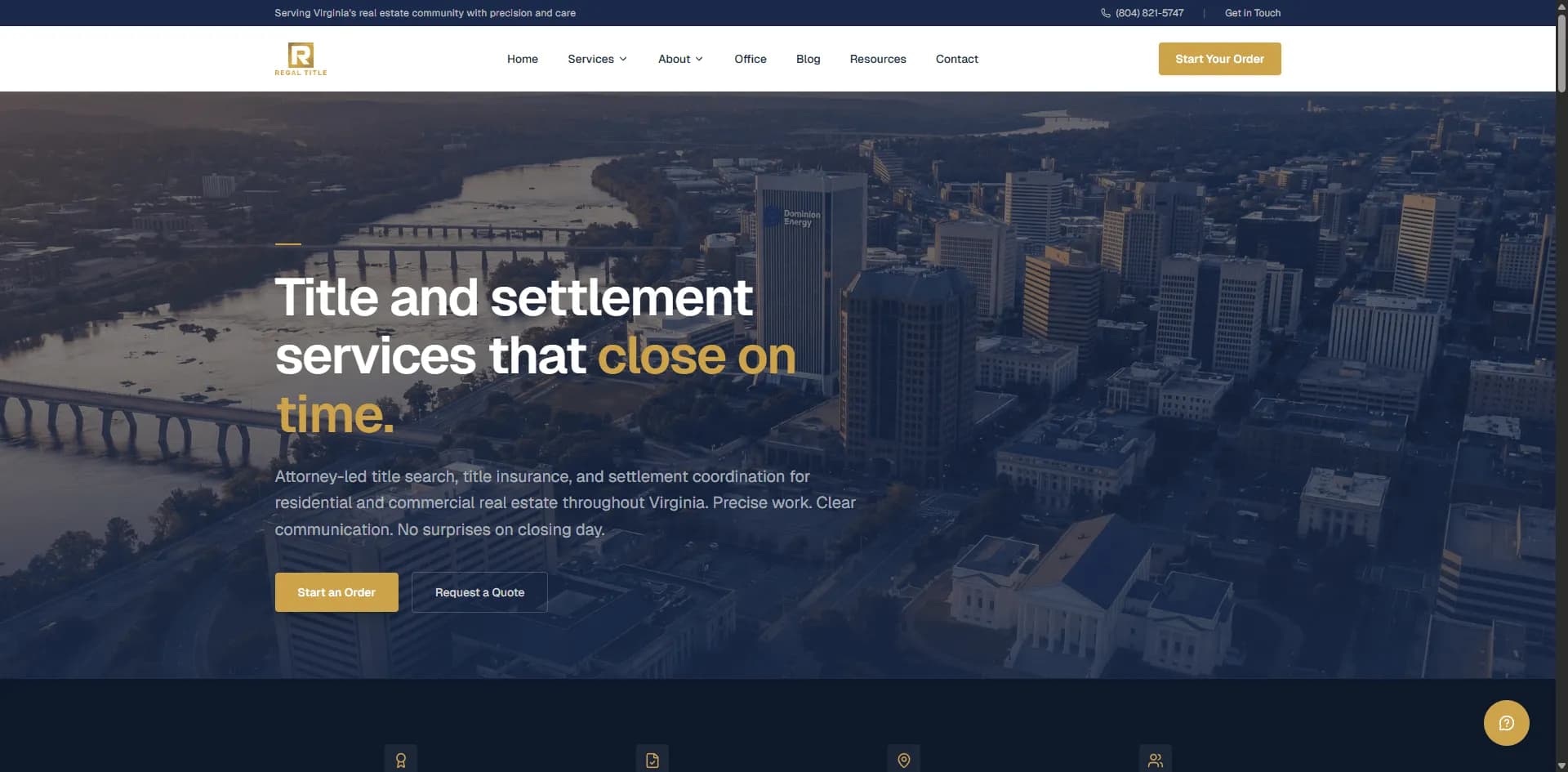
Client expected 3 months. Delivered in 3 weeks.
The Challenge
Outdated site. Manual workflows. Hard deadline.
Regal Title & Settlement needed more than a website refresh. Their existing web presence didn't project the credibility expected of a Virginia title firm, and their internal workflows relied on spreadsheets, email chains, and manual order tracking.
The brief was to build a complete digital platform: a public site that establishes trust with real estate agents and homebuyers, an admin panel for managing orders and contacts internally, and the infrastructure to support the firm's growth into new Virginia markets.
The constraint was time. The firm wanted to launch before their next marketing push, giving them 3 weeks from the first conversation.
The Solution
Four systems. Built from scratch.
Public Site
A fast, responsive public-facing website with service pages, office locations, team profiles, and an FAQ system. Designed to build trust with agents and homebuyers on first visit.
Admin Panel
A protected internal dashboard for managing title orders, tracking status through closing, and maintaining client records. Staff can update orders, add notes, and manage contacts without leaving the browser.
Contact Management
A lightweight CRM built into the admin panel: agent contacts, referral source tracking, and communication history. Everything the team needs to follow up without an external tool.
Order Tracking
Full order lifecycle management from intake to closing. Status updates, document tracking, and timeline views that give the team real-time visibility into every active file.
What Shipped
Every layer of the platform, built from scratch.
Public Website
- Service pages with structured content
- Office location pages with maps
- Team member profiles
- FAQ system with categorized questions
- Mobile-optimized responsive layout
- SEO metadata and structured data
Admin Panel
- Protected dashboard with auth gating
- Order creation and status management
- Timeline view of all active files
- Internal notes per order
- Settings and configuration panel
- Role-based access for staff
Contact Management
- Agent contact database
- Referral source tracking
- Communication history log
- Search and filter by agent or source
- Quick-add from order intake
- Export-ready contact records
Order Tracking
- Full lifecycle from intake to closing
- Status progression with timestamps
- Document upload and association
- Deadline and milestone tracking
- Assignee management per order
- Bulk status view for pipeline
Live Notifications
- Email alerts on order status changes
- New contact submission notifications
- Resend-powered transactional delivery
- Configurable notification preferences
- Staff alerts for urgent deadlines
- Client-facing status update emails
Document System
- File upload per order record
- Document type categorization
- Secure storage and retrieval
- Version tracking per document
- Bulk upload support
- Download and share links
How It Actually Got Built
The constraint. The wrong first move. The fix.
01 CONSTRAINT
A title company's credibility lives in its precision.
Regal Title needed the platform live before a marketing push with a hard 3-week deadline. Their previous agency had quoted 3 months for a fraction of the scope. The constraint was not just speed: title and settlement data is legally sensitive. Fraud warnings, attorney routing logic, and disclosure language had to be correct, or the site would create liability instead of credibility. A generic template would not pass that bar.
02 WRONG MOVE
Started with the public site. Admin panel revealed the real scope.
Week one focused on the public-facing pages, service descriptions, office locations, team profiles. Fast progress, but the admin panel discovery in week two revealed the actual complexity: order lifecycle management from intake to closing required a data model where orders, contacts, documents, notes, and assignees were all linked. Building the public site first meant the schema had to be refactored once the full admin requirements were clear. The lesson: in compliance-heavy software, nail the data model before the UI.
03 FIX
Rebuilt the schema mid-project without losing a day.
Paused the public site build in week two to re-model the database with the full order lifecycle in mind: orders linked to contacts, contacts linked to referral sources, documents linked to orders, notes tied to both orders and contacts. Once the schema was stable, the admin panel CRUD (order creation, status management, document upload, timeline views) built quickly because every query had a clean foundation. The public site resumed and completed in parallel. Zero post-launch schema changes required.
04 OUTCOME
Live in 3 weeks. Their previous agency quoted 3 months.
Full platform launched on Vercel before their marketing deadline: public site, protected admin panel, contact management, order tracking with full lifecycle from intake to closing, document upload and association, and Resend-powered email notifications on status changes. The team replaced scattered spreadsheets and email chains with a single dashboard. Their attorney routing and disclosure language passed compliance review without changes.
Timeline Breakdown
Three weeks, three phases.
Week 1
Design + Schema
Discovery call, requirements lock, database schema design, and UI wireframes. By the end of day five, the data model was finalized, the public site layout was approved, and the admin panel IA was mapped. No code was written without a confirmed direction.
Database schema finalizedUI wireframes approvedPublic site layout lockedAdmin panel IA mapped
Week 2
Build + Admin
Full-stack development sprint. Public site pages, admin dashboard, order management CRUD, contact database, and document upload system. The admin panel was functional by mid-week, with order lifecycle management and internal notes operational by Friday.
Public site pages builtAdmin dashboard operationalOrder management CRUD completeDocument upload system live
Week 3
Polish + Deploy
Responsive testing across devices, notification system wiring with Resend, performance optimization, Vercel deployment, and client onboarding walkthrough. The platform went live before the marketing deadline with zero post-launch blockers.
Responsive QA completeNotification emails wiredVercel production deployClient onboarded and trained
Before vs After
Eight manual processes. One dashboard.
Before: Manual Process
- Order tracking via spreadsheets and email chains
- Contact management scattered across inboxes
- No centralized document storage per order
- Status updates communicated by phone or email
- No visibility into pipeline at a glance
- New agents had to ask for status on every file
- Paper-heavy workflows slowed closing timelines
- Web presence did not match the firm's reputation
After: Digital Platform
- All orders tracked in a single admin dashboard
- Contact database with referral source history
- Documents uploaded and linked per order record
- Automated email notifications on status changes
- Full pipeline visibility with status-based views
- Self-serve status lookup for internal team members
- Digital workflow from intake to closing
- Professional public site built for trust and conversion
Client Impact
Three changes from launch day.
Faster Order Processing
Orders that previously required multiple emails and phone calls to track now move through a structured pipeline with status updates, timestamps, and document associations. The team processes files faster because the system enforces a clear workflow instead of relying on memory.
Digital Workflow, Not Paper
Document uploads, contact records, and order notes live in one place. No more filing cabinets, no more hunting through email attachments. Every piece of information about an order is accessible from a single dashboard view, which means less time searching and more time closing.
Real-Time Client Visibility
Agents and internal staff see live status updates without asking. Automated email notifications trigger on status changes, so clients know when their file moves forward. This reduced inbound status inquiries and gave the team hours back each week.
Tech Stack
Six technologies. Three weeks to live.
Next.js 16Full-stack framework, App Router, server components
TypeScriptStrict mode, end-to-end type safety across client and server
PostgreSQLPrimary database for orders, contacts, and documents
Tailwind v4Styling with dark-mode-first custom design system
VercelProduction hosting with edge functions and analytics
ResendTransactional email notifications for order status updates
Live in Three Weeks
3 weeks. Live. Operational.
Regal Title launched on Vercel within the 3-week window. Public site live, admin panel operational, and the team onboarded to manage orders and contacts without external tools.
The platform immediately replaced their previous workflow. Agents now see a site built for title closings, and the internal team manages their pipeline from a single dashboard instead of scattered spreadsheets and email threads.
The fastest client ship in MGT's portfolio. One developer delivered what a traditional agency quoted at 3 months in 3 weeks, because the architecture was decided before a single line of code was written.
The agency quoted 3 months. It shipped in 3 weeks.
Regal Title went from conversation to production in 3 weeks. Tell me what you need and I'll give you a realistic timeline.
From the blog
Related articles
How Much Does a Small Business Website Cost in 2026?
Template setup for $500, custom builds from $2K to $8K, complex platforms at $10K+. Here is the honest breakdown of what drives website cost, when to upgrade from a template, and why fixed pricing changes the math for small businesses.
Read articleReal Estate Website Development: What Agents and Investors Actually Need in 2026
Template sites hold agents back. Here is what custom real estate websites actually need - IDX integration, lead capture, CRM, mobile-first design - with cost breakdowns and proof from three shipped projects.
Read articleHiring a Developer: Agency vs Freelancer Marketplace vs MGT
Agencies charge $50K and take 6 months. Freelancer marketplaces are cheap but unreliable. There is a third option: one senior developer, fixed pricing, shipped portfolio, ongoing support.
Read article